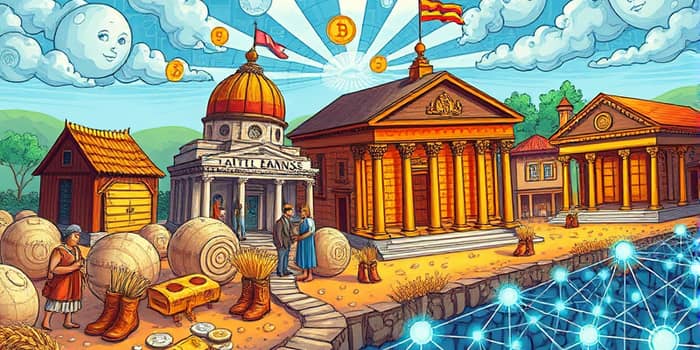
The story of lending is a testament to human ingenuity, trust and adaptation. From humble exchanges of goods to the heights of decentralized finance, each era has built upon the last, shaping our economic world.
In early human societies, survival and cooperation revolved around direct exchange. A farmer trading wheat for a shoemaker’s boots was common, but this system had limits. It required the double coincidence of wants, meaning both parties had to want exactly what the other offered at the same time.
Perishable goods, mismatched values and timing discrepancies often led to frustration. One village might have excess fish but no need for cloth; another had cloth but hungered for grain. Barter persisted despite its inefficiencies because it was the only mechanism available.
Over time, communities gravitated toward items with inherent value and wider acceptability. Cowry shells, salt, cattle and even whale teeth served as primitive money. These forms reduced the barter bottleneck by acting as a common medium of exchange.
However, trust remained personal. Accepting a cowry shell meant believing a neighbor would value it later. As scarcity and durability became prized, societies turned to metals like gold and silver. Minted coins in Lydia and Greece standardized weight and purity, simplifying transactions but also sparking issues of counterfeiting and debasement.
Merchants and farmers occasionally extended goods with a promise of future repayment, an early form of credit. These informal loans were backed by relationships more than contracts, demonstrating the enduring power of trust.
The real leap occurred in 1609 with the founding of the Bank of Amsterdam. For the first time, account holders deposited coins, received ledger balances and settled large transactions without moving physical metal. Book-entry settlements and rigorous coin certification established a new paradigm of money as ledger entries.
This innovation offered book-entry settlements without cash, reducing risk from transport and theft. Other cities soon followed, creating a network of trusted ledgers that enabled merchants to expand trade across continents.
Governments recognized the need for coordinated credit and monetary policy. Early central banks emerged to manage state debt and stabilize currencies. Below is a snapshot of pivotal institutions:
In the 19th century, the gold standard linked currencies to gold reserves, curbing inflation and fostering global stability. Central banks became lenders of last resort, ensuring liquidity during crises.
After World War II, the Bretton Woods system tied the U.S. dollar to gold. When that link ended in 1971, nations shifted to pure fiat money—currencies backed not by precious metals but by the credit of governments and public confidence.
With the advent of computers, handwritten ledgers gave way to electronic databases. Credit cards emerged in the 1950s, enabling consumers to borrow instantly against credit lines.
Financial institutions became digital intermediaries, using complex algorithms to assess borrowers’ profiles. Yet delays, fees and geographic limitations persisted, leaving many unbanked or underserved.
Blockchain technology offers a bold vision: trust via technology rather than intermediaries. Distributed ledgers record every transaction across a network, creating an immutable shared ledger viewable by all participants.
Smart contracts—self-executing code that triggers actions when predefined conditions are met—bring automated workflows to lending. Collateral, interest rates and repayments are governed by transparent rules.
The typical blockchain lending process unfolds in four steps:
Platforms like SALT Lending allow cryptocurrency holders to secure fiat or stablecoin loans with their digital assets. Automated margin calls protect lenders but can trigger rapid liquidations if markets turn volatile.
Blockchain lending bridges the gap between tradition and innovation. By eliminating many fees and delays, it elevates trust from personal relationships to cryptographic proof.
From the cumbersome barter of yesteryear to the promise of decentralized finance, the evolution of lending has been driven by one constant: the human quest for reliable exchange. Each breakthrough—from minted coins to central banking to smart contracts—has expanded access and resilience.
As technologies converge, we stand on the cusp of a financial ecosystem where anyone, anywhere can borrow or lend with transparency, security and minimal friction. The journey continues, propelled by innovation and the timeless power of trust.
References