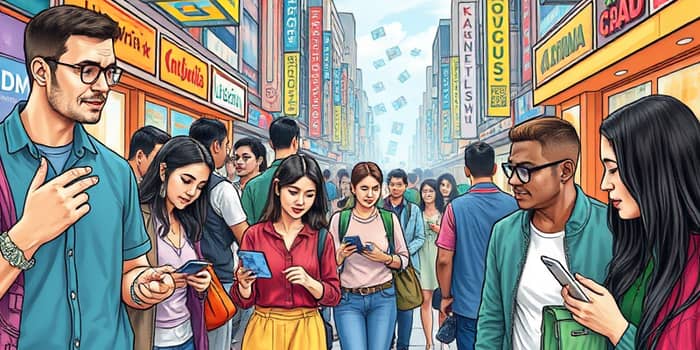
In an era where transactions vanish at the tap of a card or the wave of a wearable, the landscape of payments is shifting beneath our fingers.
The adoption of contactless card purchases worldwide is projected to grow at an average of 23% annually, surpassing 522 billion transactions by 2026. In 2024, these payments accounted for 23% of global card spending—totaling US$10.4 trillion over 456.6 billion transactions. This surge represents 42% of all card payments, a leap from 18% just one year prior.
Analysts forecast the global contactless payment market to exceed $12 trillion by 2027 at over 19% annual growth. Valued at USD 21.83 billion in 2026, the market is expected to reach USD 43.07 billion by 2032, growing at an 11.7% CAGR. By 2030, contactless transactions are anticipated to top one trillion, coinciding with five billion digital wallet users worldwide and an embedded payments market exceeding $360 billion in annual revenue.
By 2026, digital wallets will surpass five billion global users, empowering consumers to ditch physical cards entirely. This shift is more than convenience—it signals a move toward unified digital identities where payment credentials, loyalty programs, and travel passes coexist in one secure repository.
Biometric authentication stands to validate over $2.5 trillion in transactions by 2025, marking a pivotal moment for security. The adoption of fingerprint, facial recognition, and voice scans elevates fraud prevention, aligning with rising consumer demand for frictionless yet trusted experiences.
Contactless technology has penetrated every corner of the globe, but regional variations highlight unique dynamics and innovations.
In Europe, contactless constitutes over 71% of card transactions, buoyed by open banking initiatives that streamline A2A transfers and promote cross-border interoperability. Scandinavia leads on biometric terminals, while the UK champions mobile wallets across public transit.
APAC’s 82% adoption rate is anchored by super apps like Alipay and WeChat Pay, where QR codes serve both micro-donations and large retail purchases. In India, UPI-powered A2A transfers exemplify how government-backed infrastructure can achieve mass inclusion.
In North America, 96.5% of U.S. merchants now offer tap-to-pay, representing a fivefold increase since 2020. Meanwhile, Canada’s open banking roadmap promises further integration of digital and physical ecosystems.
MENA’s growing NFC footprint aligns with regional digital transformation strategies, while Africa’s tap-to-phone pilots provide merchant solutions without costly terminal investments. By the end of 2024, 89% of 180 million EFTPOS terminals accepted contactless, positioning the world for near-universal adoption by 2030.
Consumers are drawn to contactless methods for their speed, security, and simplicity, reducing checkout time by up to 40%. Improvements in infrastructure, combined with post-pandemic preferences for touch-free interactions, have solidified this shift.
Today, cards remain dominant, representing 66% of 1.7 trillion cashless transactions, though credit transfers handle 89% of cashless spending by volume. E-commerce growth at $13 trillion in 2024 accounts for 28% of card volume—a figure projected to rise as digital-first lifestyles take hold.
The trifecta of speed, security, and simplicity remains central, but personalization and value exchange are emerging as complementary drivers. AI-powered recommendations at checkout, instant cashback offers, and blended loyalty schemes enrich the payment moment and deepen customer engagement.
As the era of tap-and-go matures, innovation propels us toward increasingly seamless experiences.
Behind every tap lies a complex web of rails, regulations, and analytics. Real-time settlement platforms and open banking APIs empower personalization—from loyalty rewards to dynamic risk modeling.
Cross-border commerce rebounded to $4 trillion in 2024, driven by Europe’s Schengen zone and resumed global travel, with debit at 52% share and anticipated growth to 16% of total volume by 2030.
Yet challenges remain: bridging the digital divide in emerging markets, harmonizing regulations, and cultivating trust. Banks and fintechs are building ecosystems centered on inclusion and engagement, from healthcare check-ins to entertainment ticketing.
As we hurtle toward a world where payments are woven into the fabric of every activity, the boundary between commerce and experience will blur. Innovations such as biometric wearables, AI-driven fraud detection, and hyper-personalized offers promise to make each interaction not just a transaction, but a moment of value exchange.
Organizations that embrace invisible payment experiences at scale will cultivate deeper loyalty, unlock new revenue streams, and foster financial inclusion for millions. The future of payments is not merely about technology—it is about forging connections, building trust, and empowering individuals in an increasingly digital society.
References