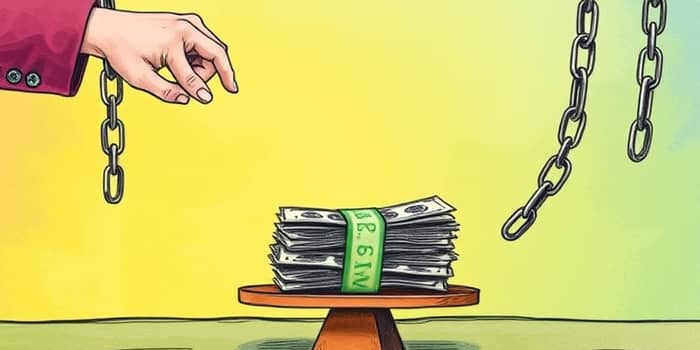
In an age of instant gratification, a short-term payday loan can feel like a lifeline. Yet, beneath the surface of speed and convenience lies a complex web of debt traps and soaring fees. By unpacking the data behind this growing market, we can empower ourselves to make informed choices and seek healthier financial solutions.
The global payday loans market has experienced rapid expansion in recent years, with projections estimating growth from $32.48 billion in 2020 to $48.68 billion by 2030. Alternative forecasts put the 2024 value at $5.4 billion, rising to $7.62 billion by 2033. This consistent momentum—driven by a compound annual growth rate between 3.9% and 5.0%—reflects both a demand for quick cash and a widening gap in financial inclusion.
Asia-Pacific, in particular, leads with a projected 5.0% CAGR as urbanization and tech-savvy youth fuel online adoption. In contrast, the US market shows stagnation, with check cashing and payday loan services growing at a 0.0% CAGR from 2020–2025. Such regional disparities highlight how local regulations, technology access, and economic pressures converge to shape borrowing patterns.
A typical payday loan amount is $375 per borrower, accompanied by finance charges of 15–20% per $100 borrowed. This translates to $56.25–$75 in fees for a two-week loan. When converted, these charges can balloon into APRs of 391% to 521%, illustrating the stark difference between advertised terms and annualized costs.
Borrowers often find that they end up paying $520 to borrow $375, according to CFPB data. State-specific examples underscore the disparity: a $300 advance in Colorado may incur $16 in fees (129% APR), while the same amount in Texas can cost $70 (582–662% APR). Over extended repayment periods, total costs can rapidly escalate, pushing families deeper into financial strain.
Costs for a $500 payday loan repaid over four months vary dramatically depending on state regulations. Reformed states with interest caps and installment options protect consumers, while no-cap states expose borrowers to usurious rates.
These figures demonstrate how state policies can make or break a borrower’s ability to repay without falling into a cycle of predatory debt.
Each year, 12 million Americans—roughly one in 20 adults—turn to payday loans to cover essentials like rent, utilities, or medical bills. The demographic profile leans heavily toward younger adults: about one-third of 25–34 year-olds carry student debt, increasing reliance on high-cost credit to bridge monthly gaps.
Small business workers have doubled their usage since 2019, and single-income households account for a disproportionate share of borrowers. Underbanked individuals, often without access to credit cards or bank loans, face rates north of 300%, making payday lenders their only feasible option.
Borrowers frequently struggle to repay original balances, leading to "loan flipping"—taking out new loans to cover existing ones. This loan flipping and debt cycles pattern traps families in perpetual repayment schemes, where only minimal principal is paid down each month.
While 45 states plus DC cap loans at $500, borrowers still face exorbitant fees and penalties. In 2023 alone, lenders raked in over $2 billion in fees. Research shows that stimulus payments and policy changes can meaningfully reduce usage: California saw a 40% drop in loans and 30% fewer users after state-level interventions.
States with reform measures—installment requirements, APR caps, mandatory ability-to-repay checks—help shield consumers from the worst abuses. A new wave of financial products, from wage-linked advances to credit-builder hybrids, offers more transparent terms and lower costs.
The online segment, growing at a 4.2% CAGR, provides borrowers with comparison tools and extended term options. Banks and fintech firms are exploring paycheck advance products that integrate directly with payroll systems, challenging traditional lenders by offering installment loans and credit-builder hybrids that reward responsible borrowing.
While payday loans can solve urgent cash needs, they should be a last resort. To build resilience and avoid predatory debt, consider the following steps:
Payday loans offer swift relief but come paired with steep costs and systemic risks. By understanding the mechanics of interest, fees, and state regulations, borrowers can weigh short-term gains against long-term impacts. With informed decisions and alternative strategies, individuals can break free from the cycle of predatory debt and chart a path toward sustainable financial health.
References