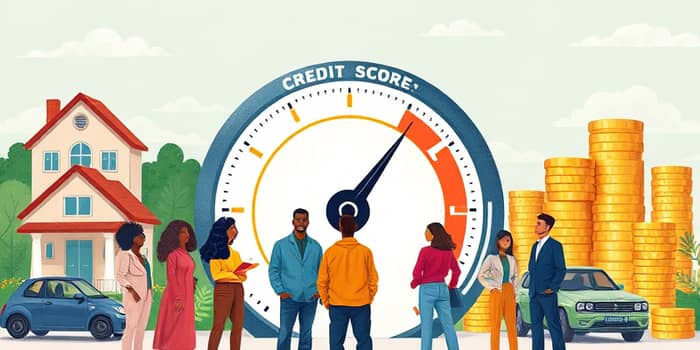
Your credit score influences nearly every borrowing decision you make, from securing a mortgage to obtaining a personal loan. By grasping its nuances and learning how lenders interpret it, you can unlock the best loan terms and pave the way toward improve your financial future.
A credit score is a three-digit number, typically between 300 and 850, designed to predict the likelihood of repayment. Lenders use this standardized metric to gauge your creditworthiness quickly and consistently.
At its core, the score reflects your historical financial behavior: how reliably you make payments, how much debt you carry, and how you manage credit over time. Keeping track of your score empowers you to negotiate better rates and qualify for more favorable loan products.
Understanding where you fall on the credit spectrum helps you set realistic goals. The table below summarizes common classifications:
Your credit score is influenced by a combination of factors, each contributing to the overall picture of financial health. The five critical elements are:
By focusing on each area, you can systematically strengthen your overall score and position yourself for better lending outcomes.
A higher credit score does more than secure loan approval; it can save thousands in interest costs over the life of a mortgage or personal loan. Lenders base their risk assessment on your score, which directly affects:
Even a modest increase in score can shift you into a lower rate tier, significantly reducing your monthly payments and total interest paid.
When applying for a mortgage, your credit score is one of the most influential variables. Borrowers with higher scores enjoy lower interest rates and more flexible loan terms. Conversely, lower scores may trigger larger down payment requirements and higher fees.
Beyond the headline rate, your credit profile also impacts:
For example, someone with a 760 score on a $200,000 mortgage could save tens of thousands of dollars in interest compared to a borrower with a 650 score.
Personal loan rates vary widely based on your credit tier. As of early 2026, average APRs by category illustrate this gap:
Excellent credit (720+): 10–16% APR for three-year terms
Good credit (690–719): 14–20% APR
Fair credit: 20–30% APR
Poor credit: 32–36% APR
Lenders such as banks, credit unions, and online platforms each have distinct ranges. Credit unions often offer slightly lower rates and fewer fees for members, especially on longer-term loans.
Many insurers incorporate credit-based insurance scores when setting premiums for auto or homeowners insurance. A stronger score can translate to reduced insurance premiums and more favorable coverage options.
Similarly, auto loans reflect credit health in their interest rates. With excellent credit, you may qualify for promotional financing deals or manufacturer incentives, reducing the total cost of vehicle ownership.
Improving your score is a marathon, not a sprint. Consistency and patience yield the best results. Key strategies include:
By adopting responsible financial habits over time, you’ll see gradual improvements and gain access to superior loan terms.
Your credit score serves as a financial compass, guiding lenders and shaping the cost of borrowing. By understanding its mechanics, monitoring your progress, and applying disciplined strategies, you can empower yourself to achieve your goals—whether that means owning a home, financing education, or building wealth through smart borrowing.
Start today by checking your score, identifying areas for growth, and committing to consistent, healthy financial habits. The journey to long-term financial freedom begins with a single, informed step.
References